applications are open and closing soon — the window started 22 August 2026 and shuts on 11 September 2026, 6:00 PM, giving you just days left if you haven’t applied yet. What’s confirmed: vacancy count, category-wise breakdown, age limit, fee, and the Recruitment Test date. What’s still pending: the detailed exam pattern (paper structure and marks split) hasn’t been laid out consistently across available information, and the admit card date hasn’t been announced.
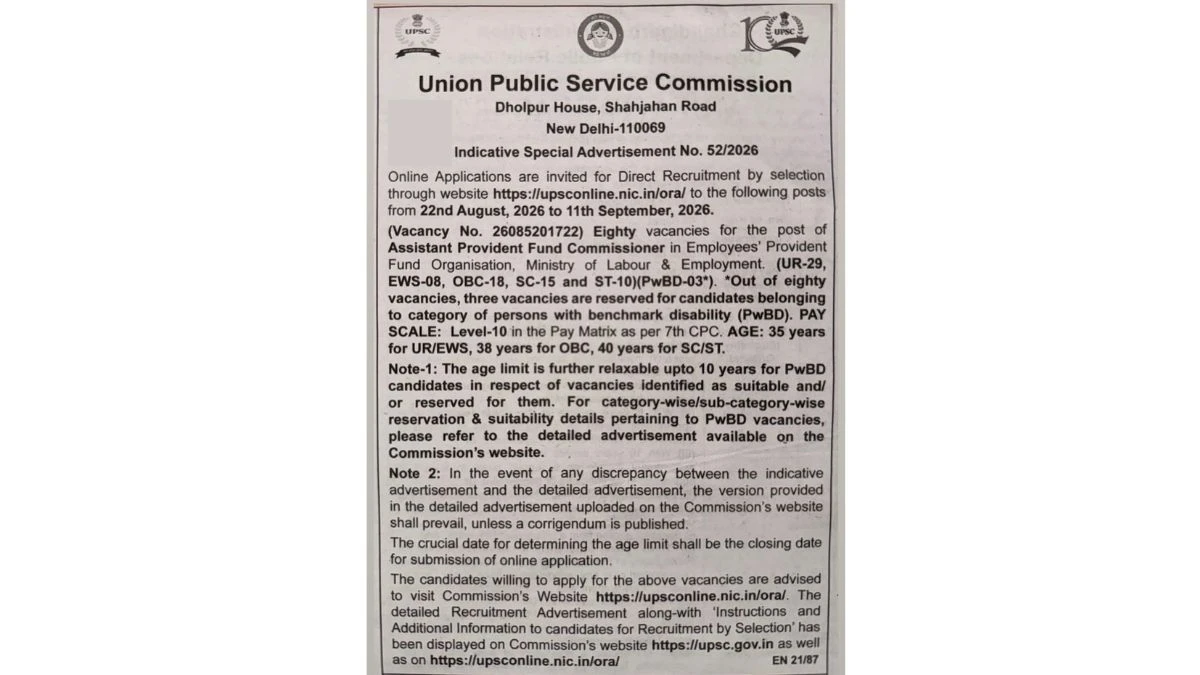
The Union Public Service Commission (UPSC) released Indicative Special Advertisement No. 52/2026 (Vacancy No. 26085201722) on 19 August 2026, with the full detailed notification following on 22 August, for direct recruitment to 80 posts of Assistant Provident Fund Commissioner (APFC) in the Employees’ Provident Fund Organisation (EPFO), under the Ministry of Labour & Employment.
Overview
| Particulars | Details |
|---|---|
| Conducting Body | Union Public Service Commission (UPSC) |
| Organisation | Employees’ Provident Fund Organisation (EPFO) |
| Ministry | Labour & Employment |
| Advertisement No. | Indicative Special Advt No. 52/2026 |
| Post | Assistant Provident Fund Commissioner (APFC) |
| Group/Grade | Group ‘A’ Gazetted |
| Total Vacancies | 80 |
| Application Mode | Online, via upsconline.nic.in |
| Application Window | 22 August – 11 September 2026, 6:00 PM |
| Recruitment Test | 20 December 2026 (pen-and-paper) |
| Pay Level | Level 10, starting basic ₹56,100 |
| Selection | Recruitment Test + Interview, weighted 75:25 |
A Notable Departure From the Usual EPFO Cycle
Worth flagging before anything else, since it matters if you were tracking EPFO recruitment expecting a different post. UPSC typically notifies APFC alongside Enforcement Officer/Accounts Officer (EO/AO) posts in the same cycle. This time, only APFC has been notified — no EO/AO vacancies alongside it. If you were specifically preparing for EO/AO under the assumption both would appear together this year, that hasn’t happened in this cycle; only the higher-entry APFC post is currently on offer.
This distinction matters practically too. EO/AO is a Group B post with a lower entry age cap (30 years for UR/EWS) and a longer promotion runway to reach APFC level — typically 5 to 7 years. APFC, by contrast, is a direct Group A entry at a meaningfully higher pay level from day one. If you’re eligible for APFC directly through this notification, you’re skipping that promotion timeline entirely.
Vacancy Breakdown
| Category | Posts |
|---|---|
| Unreserved (UR) | 29 |
| EWS | 8 |
| OBC | 18 |
| SC | 15 |
| ST | 10 |
| Total | 80 |
(Note: at least one source reports EWS at 9 rather than 8, with the UR figure adjusting accordingly to keep the total at 80. This minor discrepancy is worth checking directly against the detailed notification PDF if the EWS figure specifically affects your application.)
Eligibility
Educational Qualification: A Degree from a recognised University or equivalent. Desirable (not mandatory) additional qualifications include a Diploma in Company Law, Diploma in Labour Laws, or Diploma in Public Administration — holding one of these isn’t required to apply, but may be considered favourably at a later stage.
There’s no minimum work experience requirement specified — a fresh graduate and someone with years of professional experience apply on identical footing, which is part of what makes this one of the more broadly accessible Group A officer-level exams UPSC runs.
Age Limit
Calculated as on the last date for submission of the online application (11 September 2026). There’s no minimum age specified in the notification, only a maximum.
| Category | Maximum Age |
|---|---|
| UR / EWS | 35 years |
| OBC | 38 years |
| SC / ST | 40 years |
| PwBD | Up to 45 years (10-year relaxation, per Central Government rules) |
Salary
Assistant Provident Fund Commissioner carries Pay Level 10, with a starting basic pay of ₹56,100. Once Dearness Allowance, House Rent Allowance, and Transport Allowance are added, gross monthly pay runs to roughly ₹1.18 lakh in a metro (X-class) city, with take-home after NPS deduction and tax landing closer to ₹1 lakh — lower in smaller cities where HRA rates are reduced. Treat these as approximate figures based on current allowance rates rather than officially guaranteed take-home numbers, since allowance rates and tax treatment can shift.
Application Fee
| Category | Fee |
|---|---|
| Women, SC, ST, PwBD | Exempted |
| All other candidates | ₹25 |
A genuinely nominal fee by UPSC standards — worth noting since some candidates assume a UPSC Group A recruitment automatically carries a higher application cost.
Selection Process
Selection runs through two stages: a Recruitment Test, followed by an Interview/Personality Test for those who clear it. Final merit combines both, weighted 75:25 in favour of the written test.
The Recruitment Test is conducted offline, pen-and-paper mode, with objective-type MCQs, offered in both Hindi and English (except the English Language component, which is tested only in English).
Here’s where honesty matters more than false precision: available information on the exact paper structure for this cycle isn’t fully consistent. Some sources describe a two-paper format — a qualifying English section plus a 100-question General Studies/optional subject paper — reflecting APFC’s historical pattern. Others describe a newer, unified “Combined Recruitment Test” format of 120 objective questions for 300 marks in a single paper, which appears to reflect a more recent structural change UPSC introduced for EO/AO and APFC together. Given this inconsistency, don’t lock your preparation strategy around either version specifically — download and read the detailed notification PDF on UPSC’s official website for the paper structure that actually applies to this 2026 APFC cycle before finalizing your study plan.
Syllabus Areas (Broadly Consistent Across Sources)
Regardless of the exact paper split, the subject areas tested for APFC’s Recruitment Test have consistently included:
- General English
- Indian Culture, Heritage, and Freedom Movements
- Current national and international events
- Governance and the Constitution of India
- Present trends in the Indian Economy
- Accounting and Auditing, Industrial Relations, Labour Laws, Insurance
- Basic Computer Applications and General Science
- Elementary Mathematics, Statistics, and General Mental Ability
- Social Security in India
Given the accounting, labour law, and industrial relations weight in this list, candidates from a pure Commerce or Law background may find a natural head start over general Arts or Science graduates — though the exam remains open to any degree holder.
How to Apply
- Visit upsconline.nic.in and locate the Online Recruitment Application (ORA) link for APFC, Advertisement No. 52/2026.
- Register with a valid email and mobile number.
- Fill in personal, educational, and category details carefully.
- Upload photograph, signature, and any required documents per UPSC’s specifications.
- Pay the ₹25 fee online, if applicable to your category.
- Review the complete form before final submission — UPSC applications typically don’t allow post-submission corrections beyond a limited window.
- Submit and download/print your confirmed application for your records.
Important Note on the Notification Itself
UPSC’s own notification carries a standard but important caveat: in the event of any discrepancy between the indicative advertisement (the short, early notice) and the detailed advertisement uploaded on the Commission’s website, the detailed advertisement governs, unless a corrigendum is published. If you’ve been reading summaries based on the earlier indicative notice, cross-check any specific figure against the full detailed advertisement before relying on it.
What Happens Next
With applications closing 11 September, the next confirmed milestone is the Recruitment Test on 20 December 2026 — over three months away, giving a reasonably long preparation runway once your application is locked in. UPSC hasn’t announced an admit card release date yet; based on typical UPSC timelines, admit cards for a December exam would likely appear a few weeks beforehand, though this is an inference from past patterns rather than a confirmed date.
important links |
|
| Apply Online (Active from 22 August 2026) | click here |
| Download Short Notification / Advt. No. 52/2026 | click here |
| Official Website | click here |
| firstjob24 | click here |
| join whatsapp channel | click here |
FAQs
Q1. Is this recruitment for both APFC and EO/AO posts?
No. This cycle notifies only APFC (80 posts). No EO/AO vacancies have been announced alongside it this time, which differs from some previous EPFO recruitment cycles where both posts were notified together.
Q2. Do I need prior work experience to apply?
No. The notification doesn’t specify any minimum experience requirement — a fresh graduate and an experienced professional apply under the same eligibility conditions.
Q3. What exactly is the Recruitment Test’s paper structure — one paper or two?
This isn’t fully consistent across available sources, with some describing a two-paper format (qualifying English plus a 100-question General Studies/optional paper) and others describing a unified 120-question, 300-mark single paper. Check the official detailed notification PDF for the exact structure applicable to this 2026 cycle before finalizing your preparation approach.
Q4. What’s the fee, and who’s exempted?
₹25 for most categories. Women, SC, ST, and PwBD candidates are exempted from paying any fee.
Q5. When is the exam, and when will the admit card be released?
The Recruitment Test is scheduled for 20 December 2026. No admit card release date has been announced yet — check the official UPSC website closer to the exam date.
Disclaimer: Dates, vacancy figures, age limits, fee, and pay details above are drawn from UPSC’s official Indicative Special Advertisement No. 52/2026 and its detailed follow-up notification. The exact Recruitment Test paper structure shows inconsistency across available sources and should be verified against the official detailed notification PDF. The admit card date remains unannounced as of 6 September 2026 — check the official source for updates: upsc.gov.in / upsconline.nic.in.
